

A salaried professional holds one advantage most investors envy: predictable monthly income. So wealth building here is not about picking winning stocks or timing the market. It comes down to consistency, sensible allocation, and tax efficiency.
This guide lays out a practical strategy, with salary-wise examples, SIP allocation logic, and tax planning that actually fits your regime.
Most people search for the “best fund” first, then work out how much to invest. Reverse that order. Follow this sequence instead:
Salary → Expenses → Emergency fund → Insurance → Investments → Goals
A useful starting reference is the 50-30-20 approach: roughly 50% for needs, 30% for wants, and 20% for savings and investments. Adjust the numbers to your reality, since rent in a metro changes everything.
Two things must sit in place before your SIP does. First, an emergency fund covering about six months of expenses, parked somewhere liquid. Second, adequate health and term insurance. Without these, one hospital bill can force you to redeem investments at the worst possible moment.
No single percentage fits everyone. Still, 15% to 30% of take-home income works as a practical band once your expenses, EMIs, and emergency fund allow it.
| Monthly take-home | Suggested SIP range | Notes |
|---|---|---|
| Rs 30,000 | Rs 4,000 to Rs 6,000 | Build the emergency fund alongside |
| Rs 50,000 | Rs 8,000 to Rs 12,000 | Add insurance before scaling up |
| Rs 75,000 | Rs 15,000 to Rs 20,000 | Room for goal-based splitting |
| Rs 1,00,000+ | Rs 25,000 and above | Review asset allocation yearly |
These are illustrative ranges, not targets. Start with an amount you can sustain through a tight month, then raise it.
A SIP is a method, not a product. What you invest in should follow your time horizon. The shorter the goal, the less equity it should hold.
A vacation, a car down payment, a planned expense. Money needed this soon should not sit in volatile equity. Debt or liquid categories suit this better.
A home down payment or higher education. A balanced mix works, and the equity share should reduce as the goal nears.
Retirement or long-term wealth creation. Investors with suitable risk capacity may lean more toward equity here, since a longer horizon gives compounding room to work.
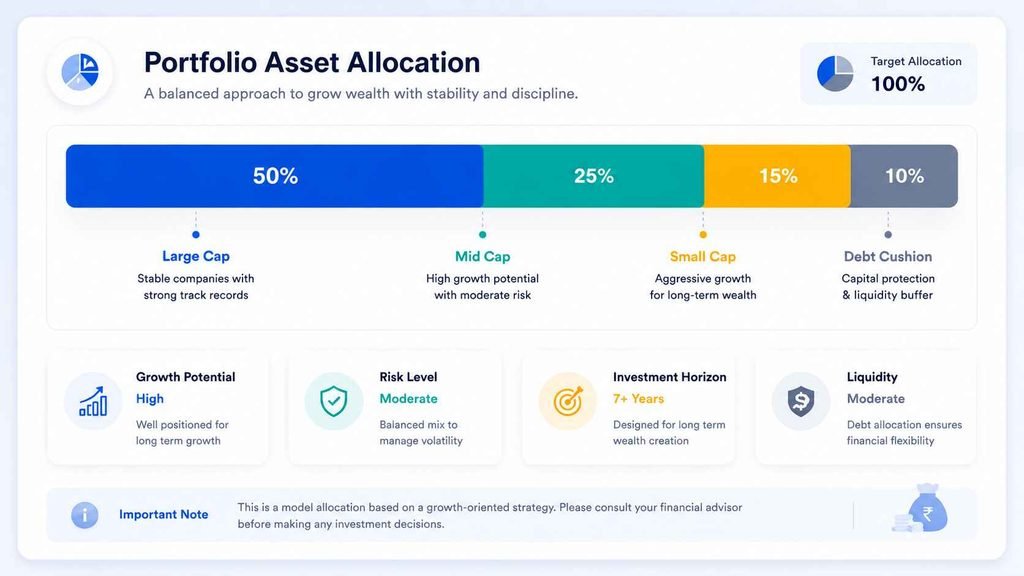
For a long-term investor with moderate to high risk capacity, an illustrative Rs 20,000 monthly SIP could look like this:
| Allocation | Amount | Purpose |
|---|---|---|
| Core equity (large cap or flexi cap) | Rs 10,000 | Stability and base growth |
| Mid cap | Rs 5,000 | Growth, with higher swings |
| Small cap | Rs 3,000 | Optional, only if risk allows |
| Debt or hybrid | Rs 2,000 | Cushion and rebalancing |
This is an example, not a recommendation. Your split should reflect your age, goals, existing investments, and risk tolerance. If you are weighing a flexi cap against a multi cap for the core slot, our comparison of flexi cap vs multi cap funds explains how the mandates differ.
Say you can invest Rs 10,000 a month. A workable structure might be Rs 5,000 to core equity, Rs 2,500 to mid cap, Rs 1,500 to another equity allocation, and Rs 1,000 to debt or a goal-specific fund. Meanwhile, keep building the emergency fund and clearing any high-cost debt.
Owning eight or ten schemes is not diversification. Often it is the same large caps repeated across four portfolios.
A workable core for most salaried investors:
Decide the mix by looking at your whole portfolio, not by picking funds one at a time. SEBI now requires monthly disclosure of portfolio overlap across equity, debt, and hybrid schemes, which makes it easier to spot funds holding the same stocks.
Tax saving matters, yet it should not be the reason you invest. Work in this order:
Calculate your tax liability → identify eligible deductions → then decide whether a tax-saving investment is needed.
Your regime decides everything here. The new tax regime is now the default, and it removes most Chapter VI-A deductions, including Section 80C. So if you are on the new regime, an ELSS fund gives you no deduction at all, and it behaves like any other equity fund.
If you are on the old regime, Section 80C allows up to Rs 1.5 lakh, and ELSS fits there with a three-year lock-in. Our detailed guide on ELSS mutual funds covers how that lock-in actually works.
One more point worth knowing: your EPF contribution already eats into the Rs 1.5 lakh limit. So check how much room is genuinely left before committing fresh money to ELSS.
Equity funds attract 12.5% long-term capital gains tax on gains above Rs 1.25 lakh in a financial year, with no indexation. Short-term gains, on units held a year or less, are taxed at 20%. Debt fund gains are taxed at your slab rate.
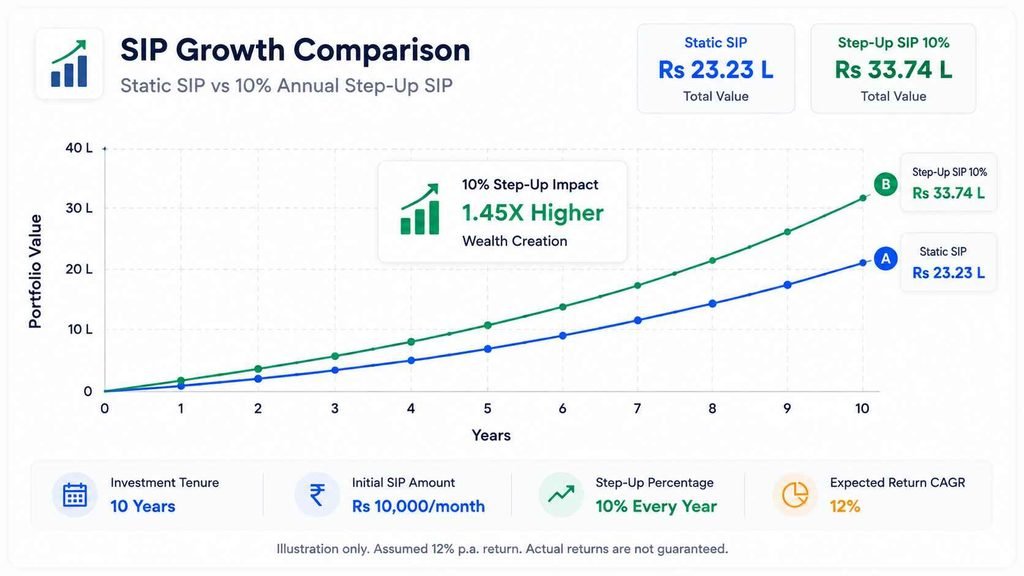
This single habit does more than fund selection ever will. A step-up SIP raises your monthly amount automatically each year, often by 10%, so your investing grows with your salary instead of lagging it.
Consider the difference. A flat Rs 10,000 monthly SIP stays Rs 10,000 for a decade. With a 10% annual step-up, it reaches roughly Rs 23,500 by year ten, and the extra contributions compound alongside. Use our SIP calculator to test both paths with your own numbers.
Volatility is normal in equity. If your goal remains long term and the fund still suits it, a market dip is not a reason to stop. Your fixed amount simply buys more units at lower prices.
That said, review the portfolio when something real changes: your goals shift, your income moves significantly, your risk tolerance changes, a goal draws near, or the allocation drifts far from plan. A yearly review and rebalance is usually enough.
Both invest in the same underlying scheme. The difference sits in cost and support. Direct plans carry no distribution cost, so they suit investors comfortable researching, monitoring, and deciding alone. Regular plans include intermediary costs and come with guidance.
The better question is not which is cheaper, but whether you want help and what you get for the cost. Our breakdown of direct vs regular mutual funds covers the trade-off in full.
The best strategy for a salaried professional is a system, not a fund. Secure your emergency fund and insurance, start a SIP you can maintain, split it by goal rather than by trend, keep the fund count low, plan tax after checking your regime, and step up the amount every year.
A Rs 10,000 SIP may look small against a retirement goal. Yet raised steadily with your income, it changes the outcome. The best time to build wealth is not when you earn more. It is when you manage what you already earn better.
Every salary, goal, and risk profile is different, so a template can only take you so far. Our advisors at MunafaWaala can help you set your allocation, choose funds that fit your goals, and structure a SIP that grows with your income. Talk to our team today and start with clarity.
Around 15% to 30% of take-home income works as a practical band, once expenses, EMIs, and your emergency fund allow it.
A SIP suits monthly income and spreads your entry across market levels. Lump sum has a role when surplus cash is available.
Only if you are on the old tax regime and have room left under Section 80C after EPF. The new regime gives no 80C deduction.
Usually three to four across categories. More schemes often mean overlapping holdings, not better diversification.
Not if your goal is long-term and the fund still fits. Falling prices mean your fixed amount buys more units.
Once a year, or whenever your income, goals, or risk tolerance change meaningfully.
Disclaimer: Mutual fund investments are subject to market risks. Read all scheme-related documents carefully.
Have a question? call us now
We are open on
Need support? Drop us an email

© 2026 MunafaWaala - All Rights Reserved


